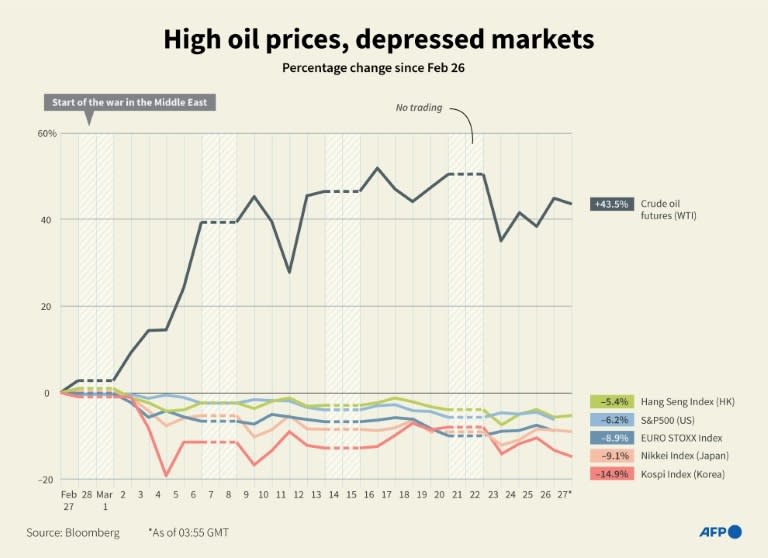
The US-Israeli attacks against Iran have triggered a series of retaliations and military escalation in the Middle East that has spooked global financial markets.
The conflict, now more than a month old, has wreaked havoc on business and energy markets, with stocks around the world facing varying degrees of exposure depending on how much they are exposed to — or benefit from — the turmoil.
Here are some of the winners and losers from the clash so far.
– Attracting investors: Oil and gas –
Iran has blocked the Strait of Hormuz, through which about a fifth of the world’s oil and gas supplies pass, sending energy prices skyrocketing.
The price swings have also boosted the ratings of major energy producers.
Profit margins for these producers have increased because while oil prices have risen, extraction costs have remained stable, said Jose Torres, senior economist at Interactive Brokers.
As a result, investors have poured money into companies that look poised to profit from a stable environment of high prices.
“They see the conflict going on for a while,” Torres said. “That means oil prices will rise systematically over the next year or two.”
In European markets, BP led the movement with a 22.3 percent gain in the one-month period from March 27 – the last trading day before the strikes – to March 27.
TotalEnergies rose 16.7 percent and Shell rose 13.3 percent over the same period.
– Pulling back: Ministry of defense –
Global conflict is often a boon to defense contractors, and overall, 2026 has seen huge gains for arms manufacturers.
In the short term, several major defense companies have seen their share prices drop since the start of the Iran war, as the market grapples with possible supply chain problems.
Although weapons are being used at a rapid pace, due to the long lead time for procurement and production, there is a delay until any increased demand can be met.
Investors “don’t see a lot of new technology being introduced,” said Sam Stovall, chief investment strategist at CFRA. “Somehow we’re still using a lot of leftover bombs”
German company Rheinmetall saw its shares fall 17 percent between March 27 and March 27, while Thales fell 6.7 percent and RTX – formerly Raytheon Technologies – fell 6.4 percent.
– Facing strong winds: Aviation –
The airline industry has emerged as one of the hardest hit sectors, as the war forces the cancellation of many flights and a major shift around disputed airspace.
Adding to the operating woes is the rise in jet fuel prices, which has made profits all over the place.
#Stock #market #winners #losers #month #USIsrael #war #Iran