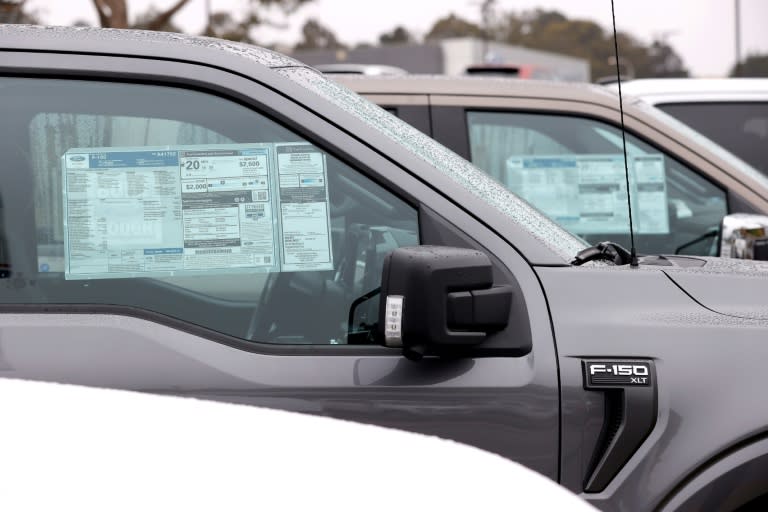
Automakers are expected to report weaker first-quarter sales in the U.S. as war in the Middle East clouded the industry’s outlook compared to last year’s extraordinary strength.
The US-Israeli attack on Iran, which began on February 28, has increased oil prices by more than 50 percent, sending gasoline prices above $4 a gallon.
While that adds to the low-cost crisis facing the industry, experts and automakers say it’s too soon to know the impact of the war on sales.
“We are definitely looking into this situation,” Toyota said. “At this stage, however, it is too early to know how the industry will be affected.”
Cox Automotive predicts that Toyota vehicle sales will drop 0.1 percent in the first quarter.
The biggest battle for the first quarter will be the strength of the market compared to last year, when concerns about tariffs expected from President Donald Trump caused buyers to rush to buy cars.
Cox Automotive expects a sales decline of more than nine percent for General Motors and Ford compared to a year earlier, as both automakers reported surprising sales amid the headlines.
Exactly how the Iran conflict affects auto sales will depend on the length of the war, especially if high inflation prompts central banks to keep interest rates high, or raise them higher.
“The current conflict in the Middle East is adding significant uncertainty to the auto market,” said Charlie Chesbrough, chief economist at Cox Automotive.
– Impact on EVs? –
Auto information website Edmunds projects US vehicle sales of 3.7 million in the first quarter, down 6.5 percent from a year ago.
“Between severe weather, political uncertainty, rising gas prices and continued affordability issues, it’s no wonder sales are down year-round,” Edmunds said.
Deutsche Bank said it did not expect a “near-term impact” from the conflict in the Mideast for the most part, confirming a sales outlook of 15.8 million this year, down 2.5 percent from last year.
Analysts following electric car maker Tesla expect it to have sold 365,645 units in the first quarter, which would be an increase of 8.6 percent from the period of 2025 but a decrease of 12.6 percent from the fourth quarter of 2025.
The outlook for EV sales has been clouded by US President Donald Trump, who has removed tax credits to encourage sales of climate-friendly vehicles.
But a prolonged period of high energy prices due to the Iran conflict could spark more interest in EVs.
Searches for EVs on Edmunds accounted for 23.8 percent of consumer inquiries in the week of March 16, up from 20.7 percent in late February.
#auto #sales #falling #auto #market #waits #impact #war