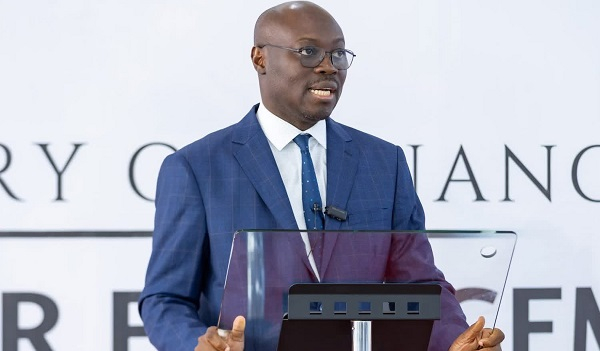
Peter Nii Charway, the CEO of Deloitte Ghana, has confirmed that the improved outlook for Ghana’s economy is creating new opportunities for small and medium enterprises (SMEs) to grow, create and attract investment, after a period of major economic challenges.
Speaking during the UK-Ghana Chamber of Commerce (UKGCC) and Deloitte Ghana webinar on “Ghana’s Economic Reset: What it means for Investors and SMEs,” Charway
noted that inflation in Ghana, after rising above 50% in 2022, has decreased to about 3.3% as of February 2026. At the same time, the Ghana Cedi, which faces extreme volatility in 2022, has emerged as one of the world’s most effective currencies in 2025.
According to Charway, this recovery is driven by a combination of fiscal consolidation, financial stabilization, credit restructuring reforms supported by the International Monetary Fund, and strong international reserves of up to $13.8 billion.
“These reforms are important to restore investor confidence and create a more predictable environment for businesses,” he said.
For SMEs, improved conditions provide opportunity and momentum especially in the agricultural, manufacturing and service sectors of the economy.
Therefore, he encouraged SMEs to improve financial behavior, keep accurate records, and coordinate their activities with these sectors to benefit from improved conditions.
“Legislation and good governance are no longer optional. They are essential for achieving financial performance and raising standards,” he noted.
Cedric McAddy, Head of Micro and Small Business at GCB Bank PLC, echoed the call for formalisation, noting that data-driven transparency allows banks to understand risk and price credit more accurately.
Problems arise and changes are needed
SMEs in Ghana face various challenges ranging from laws and regulations to weak infrastructure.
McAddy highlighted that while macroeconomic indicators are improving, access to available finance remains a major obstacle for SMEs.
Interest rates remain high despite the expected decline, and banks continue to view SMEs as high risk due to weak financial statements, lack of collateral, and unstable cash flow.
He pointed to outdated lending models as part of the problem, noting that change is needed in terms of cashflow-based lending, digital transaction evaluations, and flexible repayment structures.
Amma Gyampo, CEO of the Ghana Venture Capital & Private Equity Association (GVCA), also pointed to weak business models, poor scalability, and lack of integration in value chains as obstacles that prevent SMEs from reaching their potential.
Furthermore, Gyampo, along with Dr. George Obodum Kusi Asafo-Agyei, the Director of Monitoring and Evaluation at the Ghana Financial Promotion Center (GIPC), noted that about 75% of the funds from the funds are first used, and less than 20% are directed to SMEs or capital markets.
The presenters called for a shift towards more productive businesses, risking some of Ghana’s still currency-driven economy (T-Bill).
Cheryl Otoo, CEO of Deloitte Ghana, added that many SMEs are not aware of existing policies, incentives, and support systems, leading to underutilization of opportunities and poor decision making.
Otoo encouraged SMEs to seek advisory support and partner directly with institutions such as the Ghana Financial Promotion Center (GIPC) to position themselves in these ripe sectors.
Growth Factors in the 24-Hour Economy
According to the panel, Ghana’s economic reform, which relies heavily on the 24 Hour economic policy as a tool to drive productivity, is not enough to position SMEs for growth.
They encouraged SMEs to coordinate their activities with government-led areas, and called for corporate quality, flexibility in financial management, strategic effectiveness, and financial allocation efficiency to reap the most in revitalizing Ghana’s economy.
On top of the strategic issues facing SMEs, the webinar, moderated by George Annang of Deloitte Ghana, also explored other topics including the importance of early business relationships with banks, the strategy of prioritizing the government sector, and foreign investment as an untapped investment channel.
#Ghanas #economic #development #opens #growth #opportunities #SMEs