(Bloomberg) — Stocks fell and crude oil rose as tensions escalated in the Middle East, with Iran-backed Houthi forces entering the fray and a US military presence raising fears of a protracted war.
US equity-index futures fell 0.6% and Asian shares opened lower on Monday as the war entered its fifth week, with rising crude oil prices stoking concerns and threatening slow economic growth. Brent crude is up more than 2% above $115 a barrel. The dollar, which has emerged as the currency of choice during the war, was up 0.2%, rising for a fifth consecutive day.
Israel attacked Tehran on Sunday and Saudi Arabia intercepted about a dozen drones, a day after Yemen’s Houthi rebels entered the war. About 3,500 additional US troops have arrived in the Middle East, highlighting the risk of further escalation.
“This increase raises the possibility that this war will last longer than investors thought and therefore the price of oil will remain very high,” said Matt Maley, chief market strategist at Miller Tabak + Co. “We should expect more weakness in the markets.”
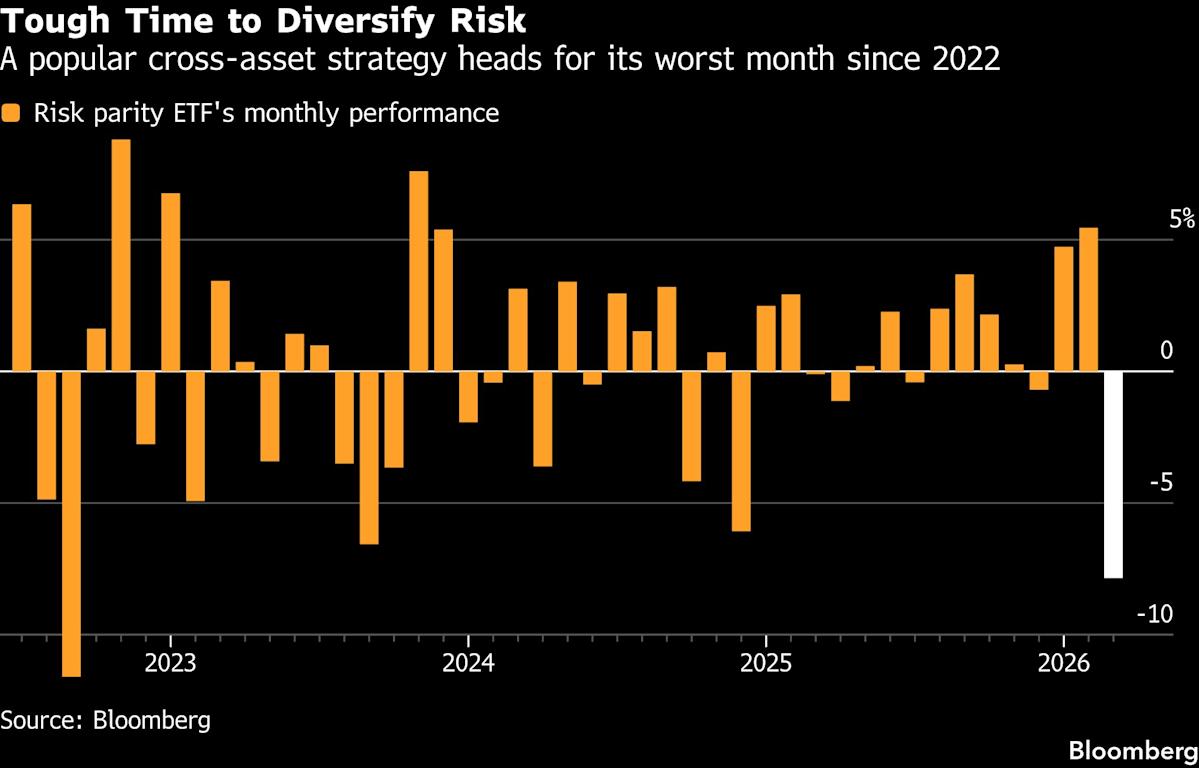
After several weeks of holding firm in the face of extreme uncertainty created by the turmoil in the oil market as the Strait of Hormuz remains closed, risk assets have shown signs of a retreat in recent sessions. The 3.6% drop in the S&P 500 over Thursday and Friday was the worst two-day decline in a year, leaving the benchmark 8.8% below its January record. The Nasdaq 100’s two-day, 4.3% slide sent it to a 10% correction.
Growing inflation concerns have driven losses in government bonds, sending yields higher and putting the Treasury on track for its worst month since October 2024 as traders assess expectations for monetary policy. Interest rate swaps do not point to a Federal Reserve interest rate cut this year, and some investors are already looking for a rate hike before the end of the year.
Bitcoin fell to its lowest level in more than three weeks as traders turned to defense after the end of the biggest election of the year, while investors continued to withdraw money from crypto exchanges. The first cryptocurrency fell almost 5% to $ 65,522 Friday, the lowest since March 2. It traded above $ 66,000 early Monday in Asia.
“Market behavior shows a clear shift to savings,” Wee Khoon Chong, chief strategist at BNY Hong Kong, wrote in a note to clients. “Recent workers remain vulnerable to interest-taking and cutbacks. However, flows are unlikely to turn meaningfully into fixed income,” he wrote, citing concerns about rising inflationary pressures.
#Stocks #fall #oil #rises #Iran #conflict #widens #market #closes