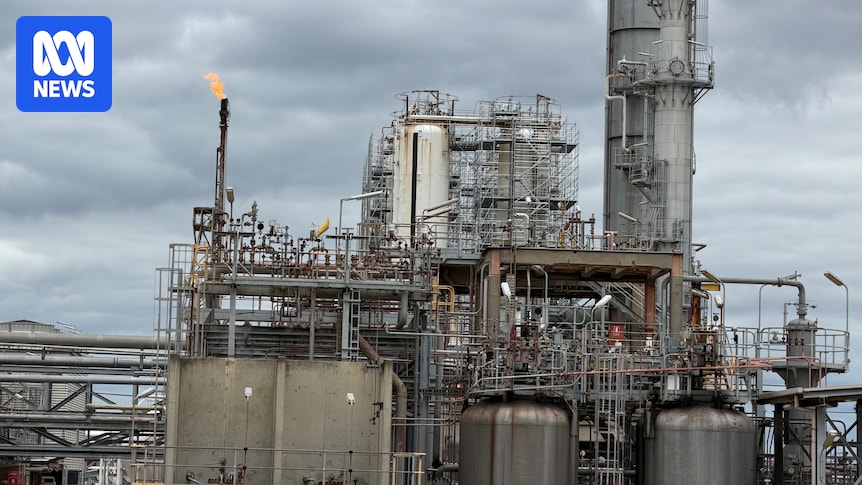
In 2013, Shell closed its Clyde refinery on the Paramatta River, and a year later, Caltex closed Kurnell in Botany Bay.
That was the time when Australia went from being self-sufficient in petrol and diesel to relying on imports.
The oil shocks of the 1970s were forgotten. We endured a decade of recession like everybody else, plus a bad recession in the middle of it, but we were 70 percent fueled by oil and gas, so at least we could get around.
The closing of the refineries seemed like a good idea at the time: they were losing money, they couldn’t compete with the bigger refineries in Singapore, Japan and Korea, and the government had just released an energy white paper that said outsourcing would work.
It said: “The reduction in domestic refining capacity in Australia (following the announcements of the Clyde and Kurnell refinery closures) is not considered to be a threat to Australia’s liquid fuel security…
Famous last words.
And to be fair, the early 2010s were the peak years of globalization, when it seemed that all trade barriers were on the same path to collapse, and the world oil price had fallen from $US115 a barrel to less than $US40 because of the US shale boom.
It was also before the United States President Donald Trump arrived and destroyed the world order, and America became a “power of reform”, as Singapore’s foreign affairs minister, Vivian Balakrishnan, said last week.
But there were signs at that time that the Strait of Hormuz should not be taken lightly.
The situation in Iran
In early 2012, Iran began enriching uranium to 20% purity at an underground enrichment facility in Qom.
The US and Europe were shocked by this and responded with severe sanctions.
The foreign assets of the Central Bank of Iran were frozen, it was cut off from the SWIFT global banking network, Europe banned the export of its oil, which was 20 percent of Iran’s exports, European insurance companies were prohibited from insuring Iranian tankers and the US said it would not do business with any country that imports Iranian oil.
Iran has said that it will close the Strait of Hormuz, that “not a drop of oil” will pass, if the sanctions are not lifted.
But the US and Europe stood firm, and the strait remained open.
Three years later, in 2015, Iran signed an agreement with the US, the UK, France, Germany, Russia and China called the Joint Comprehensive Plan of Action (JCPOA), in which it agreed to reduce its enrichment to 3.67 percent and suspend its nuclear weapons program for at least 10 years.
At the same time, another Australian refinery was closed – Bulwer Island at the mouth of the Brisbane River in Queensland. A few years later, two more refineries joined it on Australia’s self-sustainable energy pile, leaving two remaining – Ampol’s Brisbane and Viva Energy’s Geelong.
And of course, it seemed okay, or at least harmless. Iran was compliant, the port was open, and there was an abundance of oil around the world thanks to US production; On December 21, 2015, the price of crude oil hit an 11-year low of $36.05.
But in 2018, Trump scrapped the JCPOA and reinstated all previous sanctions on Iran, calling it “the worst deal ever negotiated”.
Decades of decisions will emerge
It is clear that it was not that (there are many opponents for that prize), and the doubt at the time was that he left the JCPOA because it was signed by the former president of the United States Barack Obama.
But he had a plan. The deal only lasted until 2025, did not ban long-range ballistic missiles and gave Iran a windfall that it could use to finance Hamas and Hezbollah.
But as Obama’s secretary of state, Antony Blinken, said last week: “The Obama administration put Iran’s nuclear program in a box, President Trump released it.”
However, after the JCPOA was revoked, Iran abandoned the 3.67% purity limit on uranium enrichment and demanded it.
Five years later, in March 2023, the International Atomic Energy Agency found uranium particles enriched to 83.7 percent – close to the 90 percent required to make a bomb – at its Fordo facility under 90 meters of limestone and dolomite, outside Qom.
Six months later, the Iranian-backed Palestinian group Hamas invaded Israel and killed 1,200 people, and everything in the Middle East changed again. As a result, Israel destroyed most of Gaza.
In June of last year, Trump dropped “explosive bombs” on Fordo and announced that the facility was “abolished”, but on February 28 of this year, they had to cancel it again, along with a school full of children and buildings in Tehran.
And now there is confusion. In the past few days, Trump has said at the same time that the US has won the war, it is winning the war, it does not need help to win the war, it needs help to win the war.
The “regime change”, which is the success of Israel that prompted America to attack Iran in February, cannot be achieved without a full American attack on Iran, which seems to be a step too far even for Trump.
And now the Strait of Hormuz is actually closed. Only 5 percent of normal traffic is getting through, though it’s unclear whether that’s because insurance has been canceled or because trucking companies don’t want to be brave.
On February 28, Iran’s Revolutionary Guards announced that the Strait of Hormuz was closed and threatened to “burn” any ship that tried to pass through.
A few days later, ship insurers issued cancellation notices in the Persian Gulf, which sealed it, leaving Australia with about 20 days of diesel.
So, the decisions made more than ten years ago will come back home.
Loading
This oil spill is different
Finally, it is important to understand the difference between this oil shock and the one of the 1970s.
In 1973, the Organization of Arab Petroleum Exporting Countries (OAPEC) imposed an oil embargo on the US and several other countries because of their support for Israel in the Yom Kippur War, which began with an attack on Israel by an Arab coalition led by Egypt and Syria.
Separately, they raised the non-recessionary price from $US3 to $US12 a barrel.
When the restrictions were lifted in March 1974, the price of oil never fell below $12.
It was increased again in 1979, also by a decision of the Organization of the Petroleum Exporting Countries (OPEC), under the cover of the Iranian revolution.
In 1980, the steady price was $40 – not because of a lack of supply but because of OPEC’s decisions to use its power and wealth, which the Arab countries did, happily, buying goods from the capitalist west while Iran was anti-capitalist, anti-imperialist and anti-Zionist.
This time, the price is not raised by exporters but by traders in the commodity and futures markets, responding to their predictions about supply and their sentiments.
Oil and gas producers, or at least those operating in the safe haven from Iran, love it.
The difference is that this oil contamination is very dangerous and very dangerous.
Not much, because commodity futures prices can fall faster than they rise.
Moreover, because this war is a test of patience, not like the 19-day Yom Kippur War that caused the oil panic of 1973 or the Six-Day War in 1967 that preceded it.
A long-term blockade of the Persian Gulf would be more dangerous to the world economy than a rise in oil prices, even quadrupling the 1973 level.
Inflation is bad, but the lack of fuel is crippling.
Alan Kohler is a financial anchor and columnist for ABC News and writes for Intelligent Investor.
Loading…
#Decisions #decade #hit #home